
Why 5-Star Ratings May Ignore 95% of Customer Experiences

A look at the gap between what review platforms show and what customers actually experience.
The Numbers Don't Add Up
TalkTalk serves 3.2 million customers. They have 86,327 TrustPilot reviews with a 2.8-star rating overall. That's a 2.7% representation rate – 97.3% of their customers have never left a review.
Also look at their review distribution pattern – thick green and red bars for 5-star and 1-star reviews, with barely visible slivers for 2, 3, and 4-star ratings. This "Review Canyon" pattern appears across virtually every rating platform, proving that only extreme experiences drive review behavior.
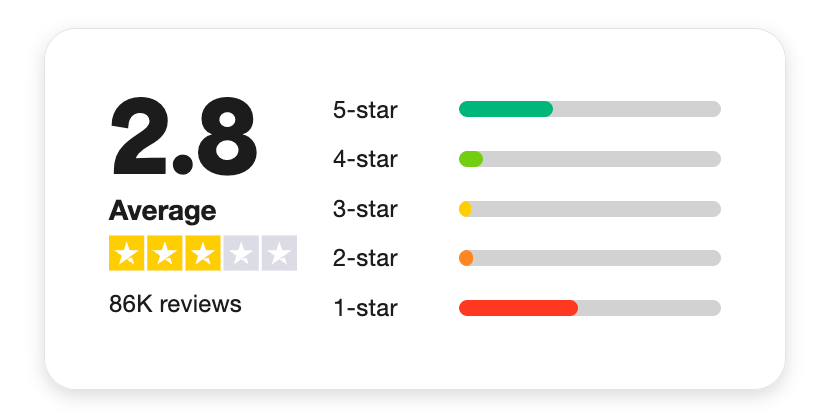
The 'missing middle' isn't just a quirk – it's a fundamental flaw that distorts how we measure customer satisfaction, trust of a brand and the general experience of consumers.
Case Study: When 99% Stay Silent
A client we recently worked with perfectly illustrates this problem. Over 12 months, they completed 12,420 transactions and received 296 reviews – representing just 2.38% of their customers.
Here's how those reviews broke down:
- 5-star reviews: 278 (93.9%)
- 4-star reviews: 11 (3.7%)
- 3-star reviews: 0 (0%)
- 2-star reviews: 2 (0.7%)
- 1-star reviews: 5 (1.7%)
Do you see what's lacking? Three-star reviews are nonexistent. This is an example of the Review Canyon effect in action. In an industry where the average order value is around £300, dissatisfied customers don't remain silent, so the 12k+ customers who didn't leave reviews weren't neutral. Their quiet signifies contentment.
Despite serving more than 12,000 happy customers a year, this company is always afraid that a few bad reviews will destroy its long fought-for 4.8-star rating.
The Star Rating Paradox
Here's why this matters: 58% of consumers put the highest weight on the overall star rating when evaluating businesses (BrightLocal Consumer Review Survey), and 74% find star ratings helpful when deciding what to buy (Feefo Consumer Trends Report).
Most shoppers aren't reading detailed reviews – they're making instant decisions based on that average score. The stakes are enormous:
- 86% of customers won't consider businesses with 1-2 star ratings
- Over half avoid anything below 4 stars
Think about this: A single number, derived from 2-3% of customers, is determining purchase decisions for the vast majority of shoppers. The rating is both sensitive to manipulation and unrepresentative of actual customer satisfaction rates.
Introducing the StoreScore: A More Representative Metric
Why can't we measure the satisfaction of ALL customers, not just the vocal 2%?
That's why we made StoreScore. Instead of relying on solicited reviews from a tiny minority, StoreScore captures >99% of transactions by assuming satisfaction by default – just like real-world shopping.
Here's how it works: After their order is delivered, your customer receives a simple message: "We assume you're happy with your purchase. If you're not, click here to let us know." Happy customers don't need to do anything. Dissatisfied customers can easily flag issues. Really happy customers can send in a testimonial if they like!
The result? A StoreScore percentage showing exactly how many transactions went smoothly over the last 90 days.
For our client case study, traditional reviews showed a 4.8-star average based on 296 reviews (2.38% of customers). But StoreScore reveals their real story: a 99.6% satisfaction rate based on nearly ALL 12k transactions.
Better Information, Better Decisions
This isn't about replacing traditional reviews – it's about giving consumers complete information and protecting genuinely excellent shopping experiences from attack.
The detailed anecdotes in 1 and 5-star reviews remain valuable for understanding specific experiences. But now shoppers also have:
- A reliable baseline: The StoreScore shows how the business performs for typical customers
- Complete context: 4.8 stars from 2% of customers vs. 99.6% satisfaction from everyone
- Confidence in their decision: No more wondering how many customers inputted to the score
For businesses, this means spending less time chasing reviews and more time improving actual customer experiences. For consumers, it means making purchase decisions based on complete data, not just the vocal extremes.
The numbers don't lie: 97-99% of your customers aren't reviewing, but they are experiencing your service. StoreScore finally measures what actually matters – and gives both businesses and consumers the confidence that comes from seeing the complete picture.
Ready to see the complete picture? Learn how StoreScore measures >99% of transactions alongside traditional reviews to give you the full story. For more on why store ratings often don't reflect most customers, read why store ratings don't represent the average customer experience.