
The Psychology of Reviews: Why Only Angry or Ecstatic Customers Leave Them
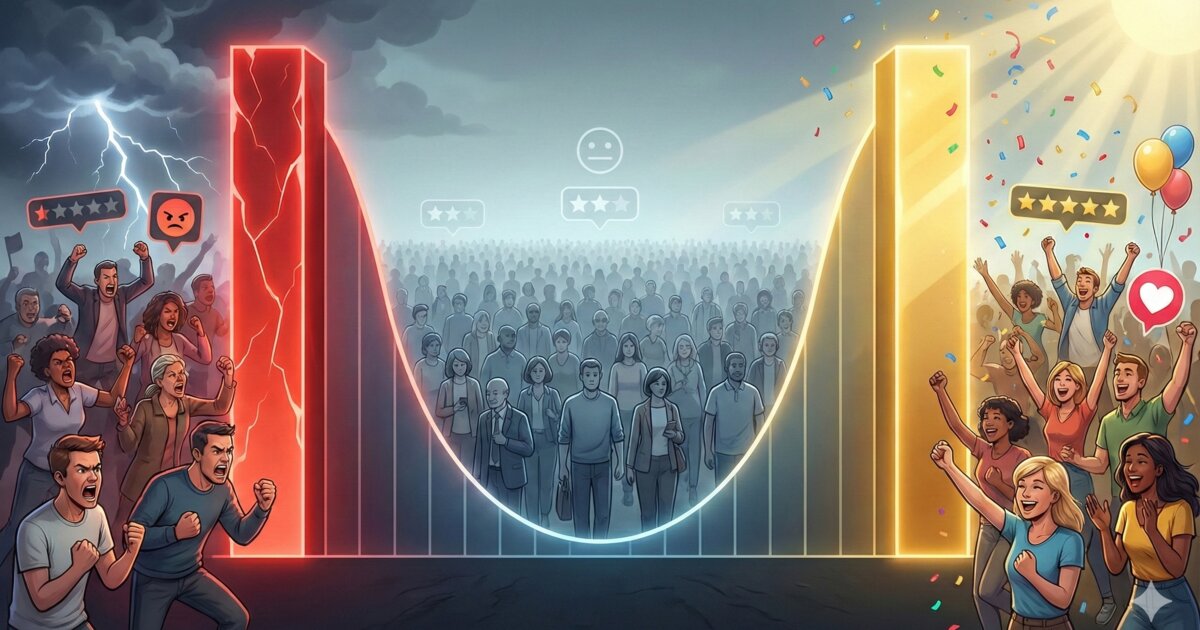
A while back we noticed that online reviews tend to cluster at the extreme ends of the rating scale.
A product with hundreds of reviews will often have a strange distribution: plenty of five-star ratings, a significant number of one-star ratings, and a barren wasteland in between. It's the opposite of a 'normal' distribution.
This is human psychology at work, and it's fundamentally distorting how we measure customer satisfaction online.
This pattern isn't unique to any particular industry; you find it in all sectors including restaurants, electronics, clothing, etc. That same U-shaped distribution appears again and again. The question is: why?
The Emotional Triggers Behind Reviews
The answer lies in understanding a fundamental principle of human behavior: we are motivated to act by strong emotions, not mild ones.
The Extremes That Drive Action
Think about your own behavior as a consumer. When was the last time you ran to the keyboard to review a product or service that was... fine?
A product that worked as advertised and caused no problems? Chances are, you (like most people) didn't bother.
Now contrast that with:
- The time a delivery arrived damaged and customer service refused to help
- The restaurant where you waited 45 minutes past your reservation time
- The hotel room that was nothing like the photos online
Or on the positive end:
- The support agent who spent an extra hour solving your complex problem
- The product that exceeded your expectations in surprising ways
- The service that made you feel personally valued and appreciated
These experiences give us stronger emotional responses – anger, frustration, surprise, delight – and that motivates us to take action. This "emotional arousal," is a key driver of review-writing behavior.
The Silent Majority: Satisfaction Without Motivation
Meanwhile, the vast majority of customer experiences fall into what I call the "satisfaction zone" – that middle ground where expectations are met but not dramatically exceeded, and where no significant problems occur. These experiences make up the bulk of consumer interactions, yet they remain virtually invisible in our review systems.
Why? Because satisfaction alone isn't emotionally arousing enough to motivate review-writing behavior. When things go as expected, our brains simply don't generate the emotional response required to overcome the friction of logging in, writing thoughtful comments, and submitting a review.
The Psychological Biases Shaping Review Systems
This pattern is reinforced by several powerful psychological biases that further distort our review landscapes:
Negativity Bias
Humans tend to give more weight to bad experiences than positive ones – it's an evolutionary adaptation that helped our ancestors avoid danger. This negativity bias means we're more likely to want to warn others about bad experiences than to praise acceptable ones.
Peak-End Rule
The Peak-End Rule developed by psychologist Daniel Kahneman, demonstrates that we judge experiences mainly based on how they felt at their peak (the most intense point) and at their end, rather than evaluating the entire experience objectively.
For online purchases, this often means that a last-minute delivery problem or packaging issue can overwhelm an otherwise positive experience, driving a disproportionate number of negative reviews.
The Mathematical Distortion
The combination of these psychological factors creates a powerful selection bias in who leaves reviews. If we look at the mathematical implications:
- Only about 1% of customers leave reviews at all
- Of that 1%, the majority are responding to extreme experiences
- The remaining 99% of customer experiences – mostly satisfactory – go unrecorded
This creates a dramatic statistical distortion. Imagine if we tried to measure the average height of the population by only measuring people who were either under 5 feet or over 6'5". We'd end up with a completely inaccurate picture of human height distribution, yet this is effectively what we're doing with customer satisfaction measurements.
For businesses, this distortion is particularly problematic because it creates perverse incentives. Rather than focusing on improving overall service for the majority of customers, they're forced to engage in extreme measures to prevent rare one-star scenarios or to manufacture artificially "delightful" moments that might trigger five-star reviews.
Giving a Voice to the Silent Majority
The "Satisfaction by Default" Principle
When you walk into a physical store, make a purchase, and leave without complaint, both you and the store reasonably assume the transaction was satisfactory. You don't need to sign a feedback form confirming your basic satisfaction – silence is correctly interpreted as acceptance.
StoreScore brings this natural assumption to the digital world. By counting every successfully completed transaction and only requiring action from dissatisfied customers, we create a complete picture that includes the previously invisible "satisfied majority."
Instead of star ratings based on a tiny, unrepresentative sample, StoreScore provides a completion rate that shows what percentage of all transactions were successfully completed without issues over the past 90 days.
This approach:
- Reflects the experiences of 100% of customers, not just the vocal 1%
- Eliminates the distortion caused by emotional motivation bias
- Creates a more balanced and accurate picture of business performance
- Frees businesses to focus on steady, consistent service rather than extremes
A New Approach: Balanced Feedback Systems
This isn't to say that traditional reviews have no value – they provide important qualitative feedback and insights into both problems and delights. The detailed feedback from a customer who experienced an issue can help businesses identify and fix process problems. Similarly, understanding what genuinely delights customers can help businesses prioritize their investments.
The ideal approach combines the representative quantitative metrics of StoreScore with the rich qualitative insights of traditional reviews. Together, they provide a complete picture: how the business performs overall, plus detailed stories from the extremes that help drive improvement.
Conclusion: Understanding the Silent Majority
The psychological forces that drive review behavior are powerful and deeply ingrained in human cognition. We cannot change these fundamental aspects of human psychology – but we can design measurement systems that account for them.
By understanding the silent majority of satisfied customers and giving them a voice through better measurement systems, we create a more accurate and fair marketplace for both businesses and consumers. We move beyond the distorted picture created by emotional extremes and build a more reliable foundation for measuring what truly matters in customer experience.
The future of customer feedback isn't about getting more reviews – it's about getting a more complete picture. And that means finding ways to count the quiet, satisfied majority whose experiences matter just as much as the vocal extremes.